Yesterday we sang "Lift Every Voice and Sing" together. When the room locked into a cappella in Round 3 — ONE word that describes how it felt. Write it on the top corner of your index card. Then 30-second pair-share with your neighbor.
"The word that came up for me from yesterday's a cappella was _______."
I can PERFORM the chorus of "This Little Light of Mine" using stamp-clap-stamp-clap body percussion (feet 1+3, hands 2+4) by singing the English chorus, joining the Spanish refrain "Esta lucecita mía, la voy a dejar que brille," and pouring my personal commitment into an "I-song" of the Civil Rights Movement.
L47 was anthem #1 (Lift Every Voice) – the showcase opener. L48 is anthem #2 (This Little Light of Mine) – the showcase closer. Two anthems, two civil-rights traditions, one bilingual room.
30 sec • 90 bpm
Tap R-L-R-L at the click. Feet only. Arms still. Builds the FLOOR.
30 sec • 90 bpm
Clap on 2 + 4 only. Feet still. Builds the BACKBEAT — where the snare lives.
45 sec • 45 bpm
Stamp 1 + 3, clap 2 + 4. SLOW. Slow first — speed comes later.
75 sec • call & response
I clap a 4-beat phrase. You echo it back. 4 rounds, building complexity.
Feet isolation → hands isolation → slow combo → ear-and-echo. By minute 5 the percussion skill is awake. Different from the Do Now (cognitive) on purpose — this prepares the body for the day's main work.
Which body part wants to fight you the most — feet, hands, or both?
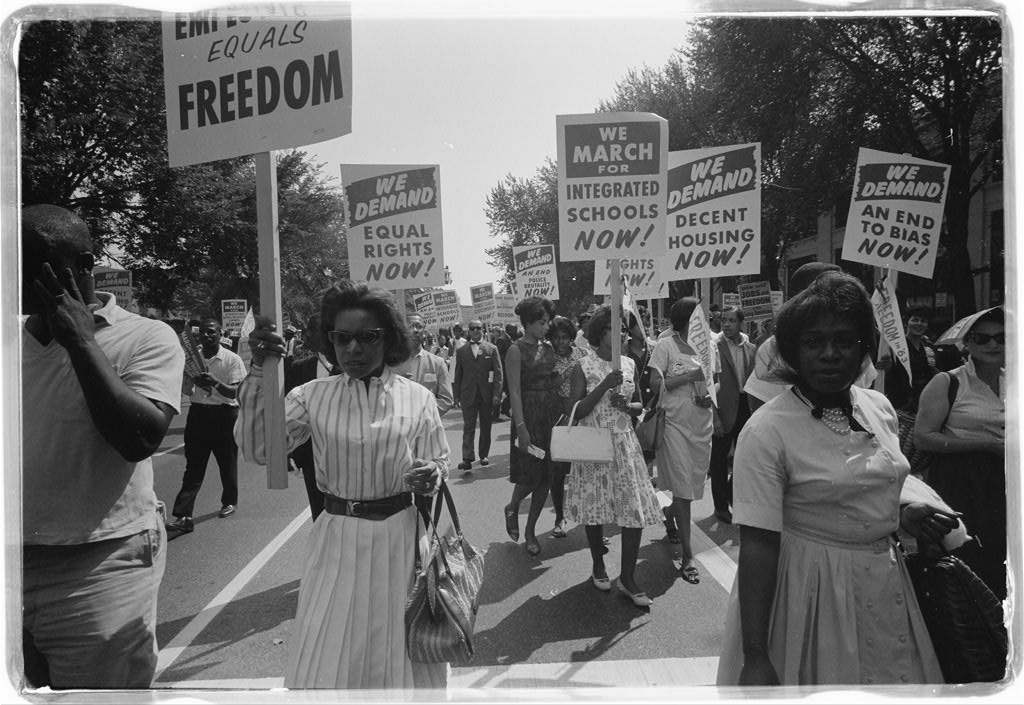
Fannie Lou Hamer at the 1964 Democratic National Convention. Photo: Warren K. Leffler, Library of Congress (public domain).
A 1920s gospel song with disputed authorship. (Harry Dixon Loes wrote the popular 1940s arrangement but never claimed the original.) At the Highlander Folk School in Tennessee, civil-rights organizer Zilphia Horton and Fannie Lou Hamer (Mississippi voter-rights leader) added freedom verses – "I’ve got the light of FREEDOM." Kay Mills wrote: "If Mrs. Hamer had a theme song, it was This Little Light of Mine."
Bernice Johnson Reagon (founder of the SNCC Freedom Singers and Sweet Honey in the Rock) said this:
"This song was sung MORE than 'We Shall Overcome.' It's an I-song. It gives you a chance to pour into the sound of your singing voice your individual personal commitment to be in the freedom struggle."
I – not WE. Today we earn the right to say it. Three checkboxes: hold the body pattern, sing in English, join the Spanish refrain. Then ONE sentence: what word did YOU pour into "I'm gonna let it shine"?
Reagon called it an "I-song." Tell your neighbor: when did you last pour personal commitment into ANYTHING? (Game, song, argument, parent moment, workout.)
This pattern is paired with this song since at least 1959 — field recording from Tyro, Mississippi at the Independence Church (James Shorter & congregation). The Library of Congress / Smithsonian Folkways teach it the same way. We are joining a 67-year body-percussion line.
How is doing TWO pulses at once (feet 1+3 / hands 2+4) DIFFERENT from clave clapping where everyone claps one pattern?
3 min • 90 bpm
Stamp on beats 1 + 3. Hands at side. Lock the FLOOR in before adding anything.
3 min • 90 bpm
Clap on beats 2 + 4. Feet still. This is the BACKBEAT — where the snare lives.
2 min • 45 bpm
Slow it down. Stamp 1 + 3, clap 2 + 4. Slow first, fast later.
2 min • 90 bpm
Both at full speed. 16 bars without stopping. I step OUT — the room holds itself.
PERIOD 2 PROTECTION: If a scholar can't combine feet + hands yet, they stay on FEET-ONLY and earn full credit. Movement Captain role available — they call the layer transitions instead.
Which body part is harder for YOU to keep steady – feet or hands? Why?
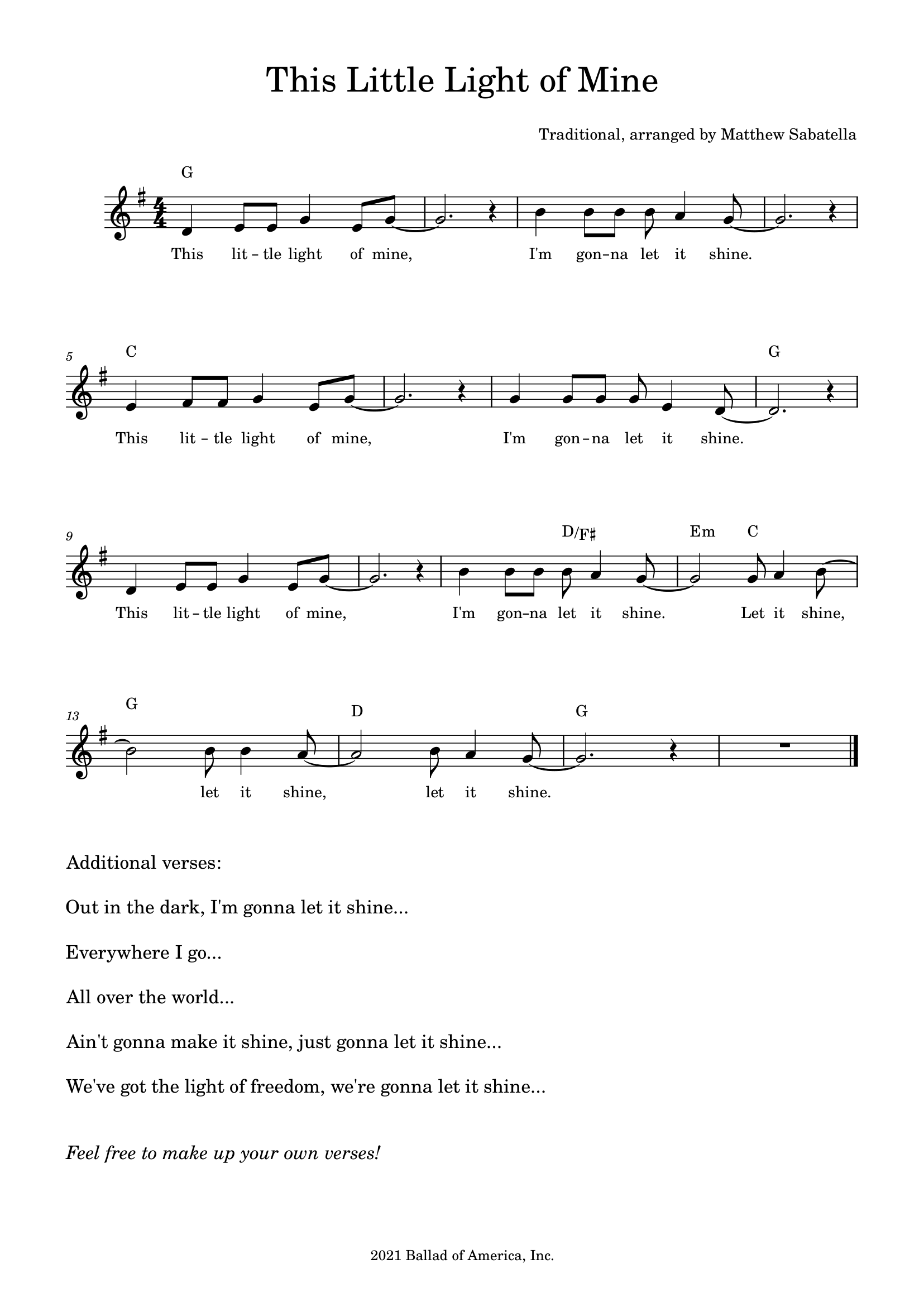
This little light of mine,
I'm gonna let it shine.
This little light of mine,
I'm gonna let it shine.
This little light of mine,
I'm gonna let it shine.
Let it shine, let it shine, let it shine.
Esta lucecita mía,
La voy a dejar que brille.
Esta lucecita mía,
La voy a dejar que brille.
Esta lucecita mía,
La voy a dejar que brille.
¡Que brille, que brille, que brille!
Teach order: English call-response (3 min) → sing English over the body pattern (3 min) → Spanish call-response (2 min) → alternating English / Spanish, body pattern continuous (2 min).
Why does singing the chorus in BOTH English and Spanish make this room's version of the song different from the 1959 Mississippi version — AND why does that matter?
4 bars of stamp-clap-stamp-clap + English chorus. Eyes on partner. Voice full.
One STAR ("the strongest thing was ____").
One WISH ("next time try ____").
Then SWAP. Both partners earn the 1 Star + 1 Wish exchange. Specific feedback only: no "you were good" — tell them WHAT was good.
📝 WRITE IT ON YOUR INDEX CARD. I handed each of you ONE index card at the door. Write your Star + Wish on the TOP HALF of the card now. You will use the BOTTOM HALF for your Exit Ticket in 3 minutes. Keep the card; turn it in at the end.
What does specific, useful feedback sound like? Give one example of a Star and one of a Wish that you'd want to hear.
Check the box for each task you completed today (1 point each):
☐ Held stamp-clap-stamp-clap through the chorus
☐ Sang the chorus in English
☐ Joined the Spanish refrain "Esta lucecita mía"
1 pt per checked box • Max 3 pts
Reagon called this an "I-song." In ONE sentence: when you poured your own personal commitment into "I'm gonna let it shine," what word came up for you, and why?
"The word that came up for me was ___________ because ___________."
1 pt = Names a specific word • 1 pt = Explains why with personal detail
📝 ON THE BOTTOM HALF OF YOUR INDEX CARD: Check the 3 boxes (Q1) + write ONE sentence (Q2). Same card from the Pair Performance — Star + Wish on top, Exit Ticket on bottom. Turn the card in to me when you leave.