Lesson 38 (P6): We Sing Because We Must 1 / 12
100%

Lift Every Voice and Sing

Levanta Cada Voz y Canta
Verse 1 + Chorus • A Cappella
Verso 1 + Estribillo • A Cappella
Wednesday, April 29, 2026 • Period 6 (11th Grade) • Music Studio • Mr. Mbagwu
Unit 5: Music as Social Commentary – Week 12 – Lesson 38 (P6)
← Wed Clave (P2)

Humming Wake-Up

Despertar Tarareando
03:00

Stay seated. Close your mouth gently. Hum a pitch you find easy. Hold it for 4 seconds. Stop. Hum again. Notice where you feel the buzz – lips? cheeks? chest?

Quédate sentado. Cierra la boca suavemente. Tararea un tono que te resulte fácil. Sosténlo 4 segundos. Repite. Nota dónde sientes la vibración.
DOK 1 – RECALL

Where in your body did you feel the hum?

I Can…

Yo Puedo…

I can match pitch and sing verse 1 of "Lift Every Voice and Sing" in unison with the class, and explain why group singing has been central to social movements.

Puedo afinar y cantar el primer verso de "Lift Every Voice and Sing" al unísono con la clase, y explicar por qué el canto grupal ha sido central en los movimientos sociales.
UNIT 5 • WEEK 12 • THROUGHLINE

You’ve studied protest music, written your own lyrics, and listened for sound as message. Today we ADD our own voices. You can’t Google what 30 voices feel like in one room. You have to be in it. The same song sung today connected enslaved people in 1900 to civil rights workers in 1960 to you in 2026. Singing together IS the social commentary.

Hoy añadimos nuestras propias voces. La misma canción cantada hoy conectó a personas en 1900, en 1960, y a ti en 2026. Cantar juntos ES el comentario social.

Wake the Voice — Prep the Song
Despierta la Voz — Prepara la Canción
05:00
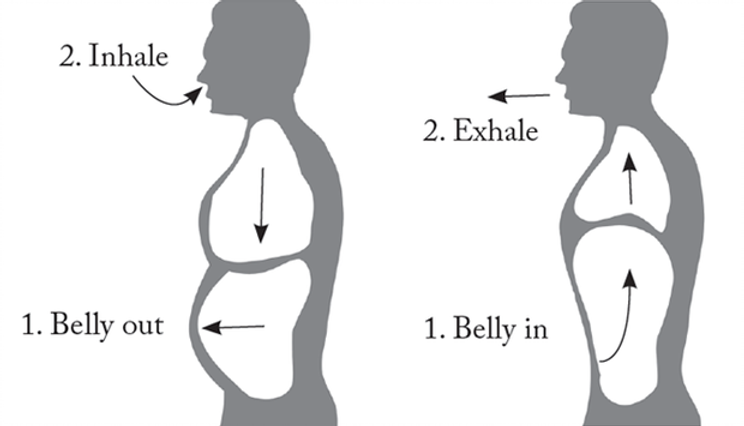
Diaphragmatic breathing diagram: inhale belly out, exhale belly in

1. Posture & Breath

Stand tall • shoulders down • hand on belly. Inhale 4 counts (belly OUT) • exhale on "sss" 8 counts (belly IN). Repeat 4×.

Why: Verse 1 has long phrases ("Ring with the harmonies of liberty"). Belly-breath = sustain.

75 sec
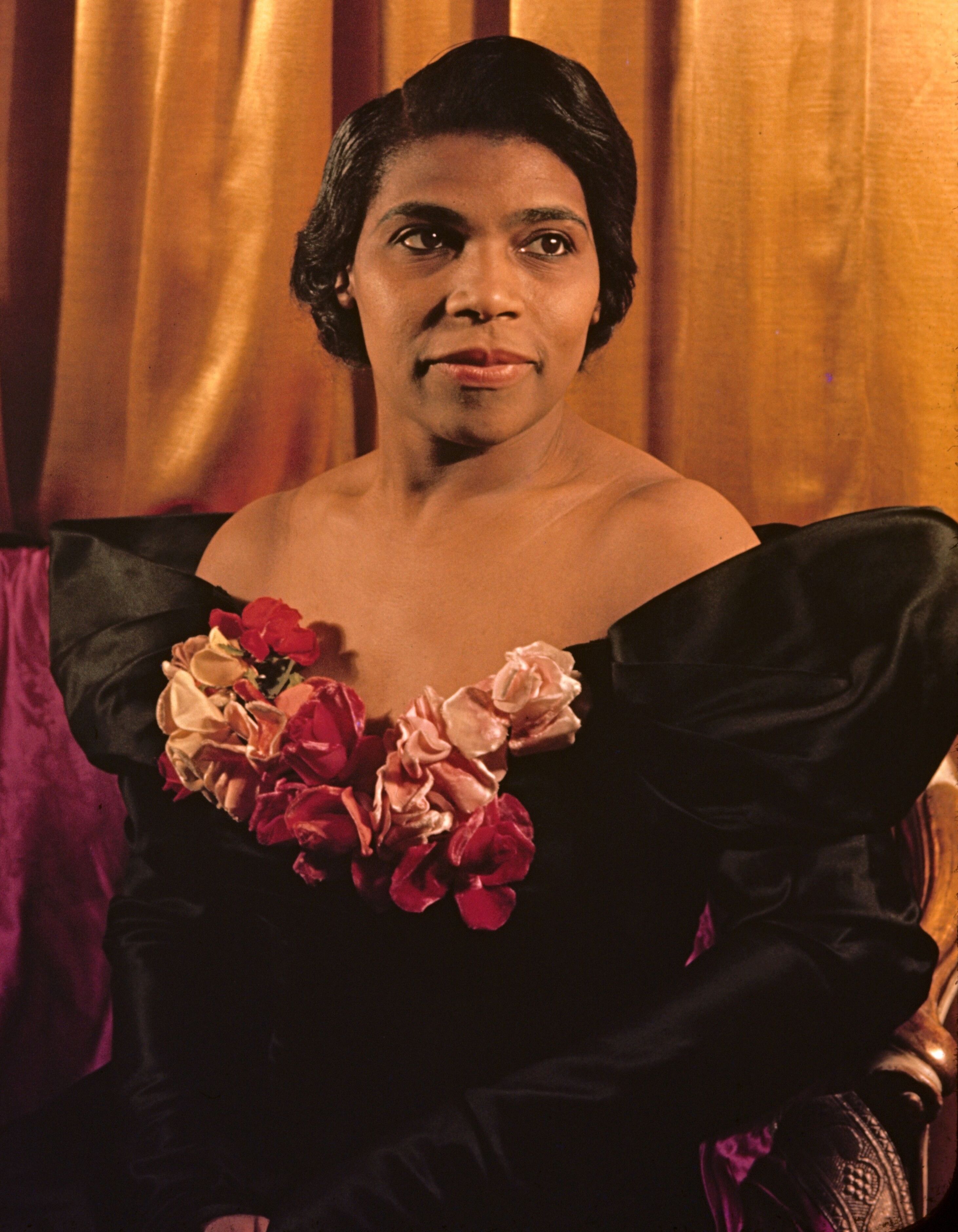
Marian Anderson — iconic Black American contralto, 1940 portrait by Carl Van Vechten

2. Lip Trills on G

Sustained "brrrr" on G (the song’s home note) • slide up to D and back. 4 cycles.

Why: Marian Anderson, who sang at the Lincoln Memorial in 1939 to 75,000 people in protest of segregation, used trill exercises to control breath without strain. Sets the ear in G major.

75 sec
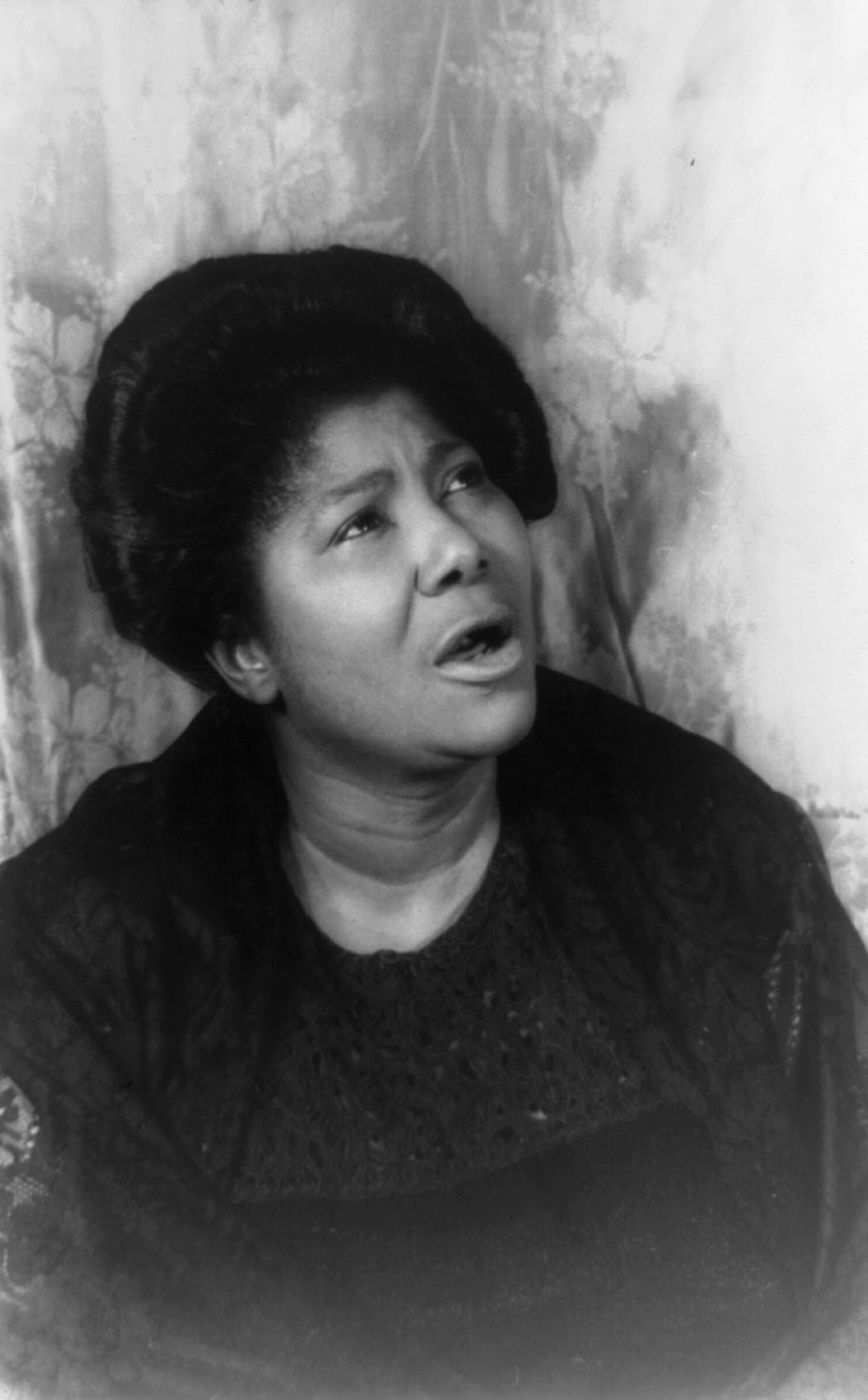
Mahalia Jackson, Queen of Gospel, 1962 Library of Congress portrait

3. "NG" Sirens

Hum on "ng" (like the end of "sing") gliding low → high → low. 3 glides.

Why: Mahalia Jackson, the Queen of Gospel who recorded Lift Every Voice, reached the back of every church with her head voice. The "ng" lifts the soft palate — that’s how.

75 sec
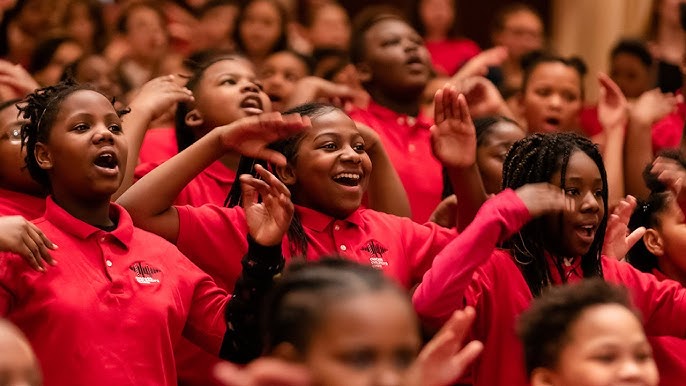
Children's choir in red shirts singing together with hands raised

4. Echo the First Phrase

Mr. Mbagwu sings "Lift ev’ry voice and sing" on the song’s actual melody • class echoes. 3 times.

Why: 500 Black schoolchildren sang this song first — Jacksonville, 1900. We join that line. Locks pitch + rhythm + diction before the formal teach.

75 sec

Each step builds on the last: breath → voice on G → head voice for highs → the song itself. By minute 5, the room is ready.
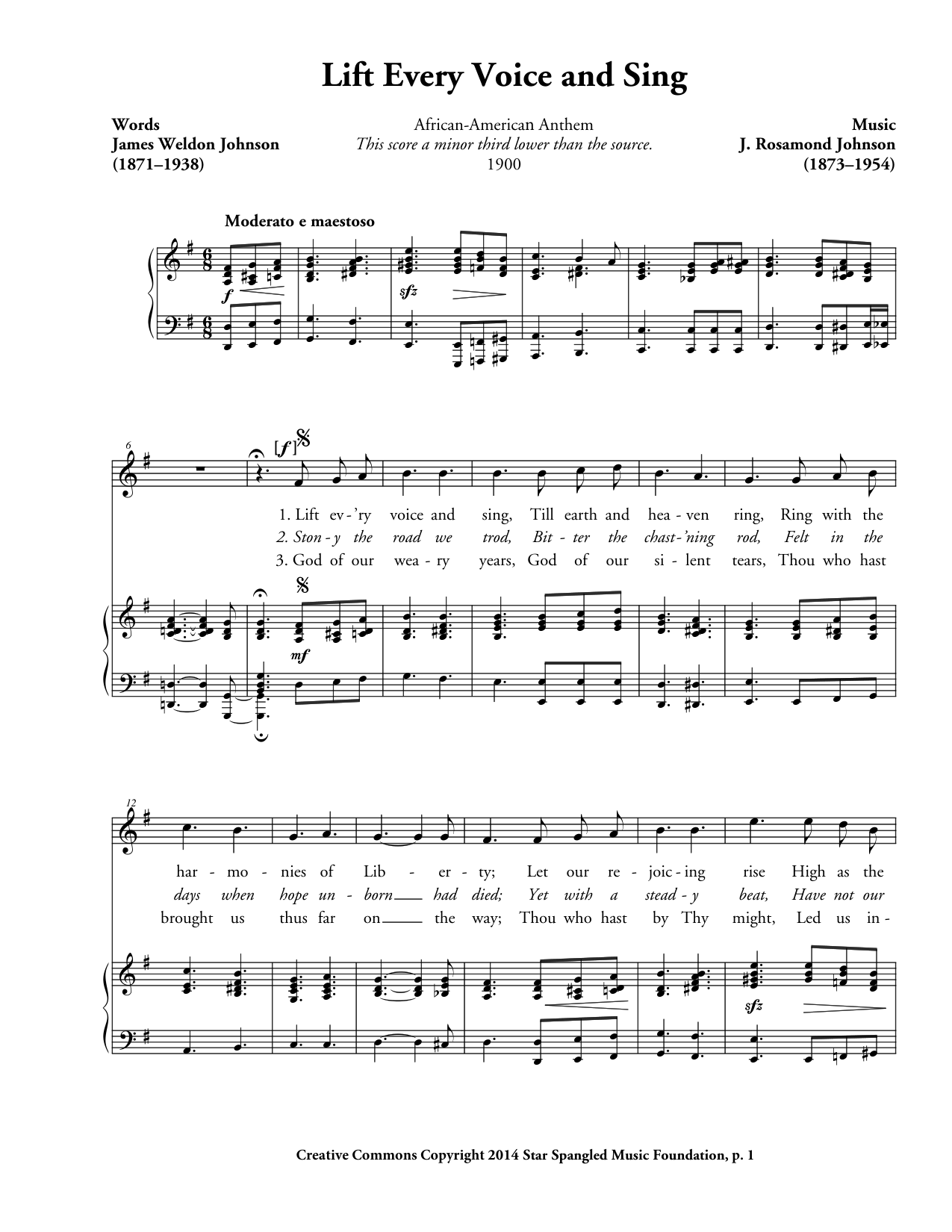
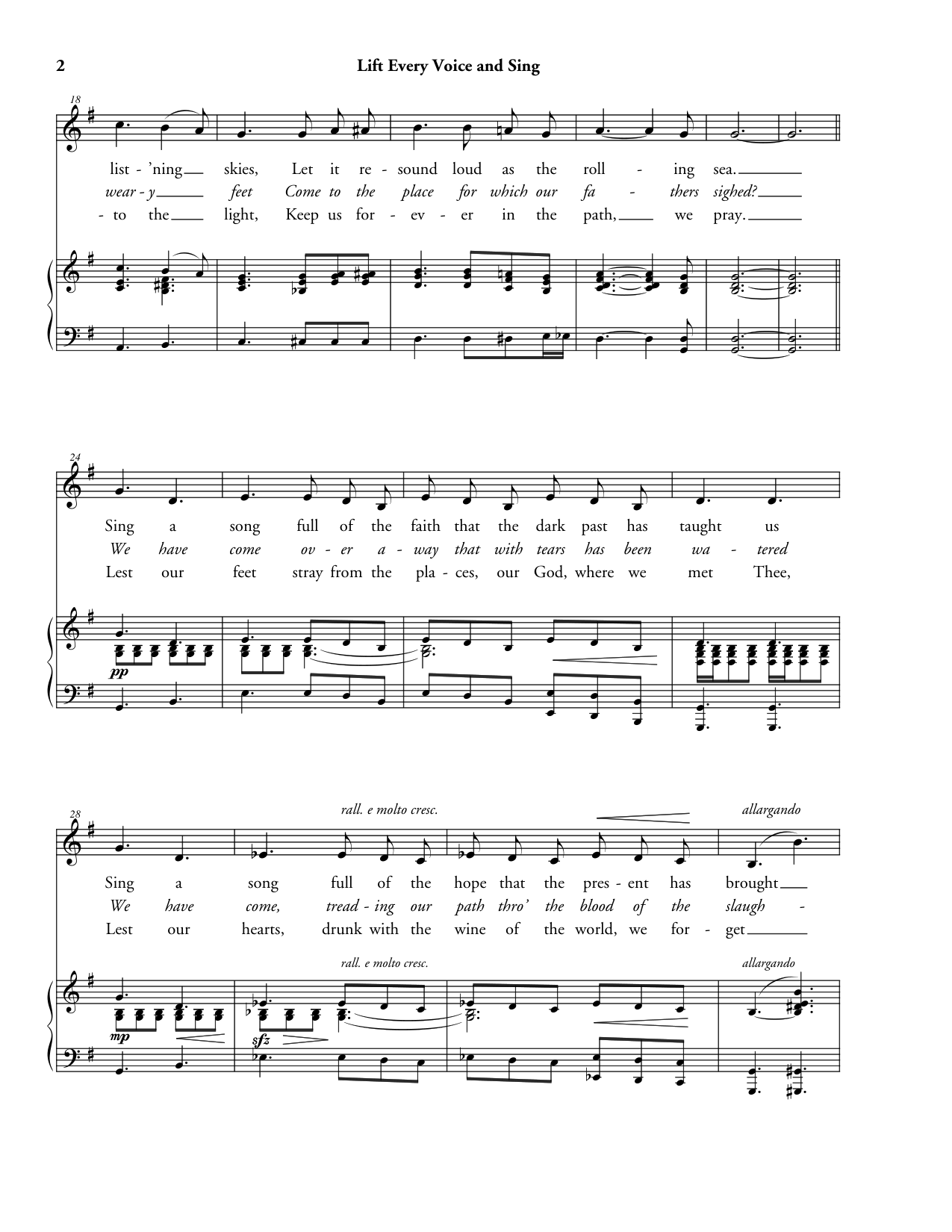
"Lift Every Voice and Sing"

"Levanta Cada Voz y Canta"

Jacksonville, Florida — February 12, 1900

Two brothers, both Black: James Weldon Johnson wrote the words; his brother J. Rosamond Johnson composed the music. James was principal of Stanton School, a segregated public school for Black children. The song was written for a school program celebrating President Abraham Lincoln’s birthday, with Booker T. Washington as honored guest.

It was first sung by 500 Black schoolchildren at Stanton School. The schoolchildren learned it. Their parents learned it. It traveled.

Adopted by the NAACP — 1919

Nineteen years later, the NAACP officially adopted the song as the "Negro National Anthem" (a name that has evolved to "Black National Anthem"). For more than a century since, it has been sung at civil-rights gatherings, in Black churches, at HBCU graduations, at funerals, at protests, and in 2020 at the funeral for John Lewis on Capitol Hill.

Three verses. Today we focus on verse 1 + the chorus. A cappella by the end.

Full title: "Lift Every Voice and Sing." Written 1900 • Adopted by NAACP 1919 • Sung continuously for 126 years.

DOK 1 – RECALL

What is the song’s full title? Who wrote the words and the music? Where was it first sung?

100%
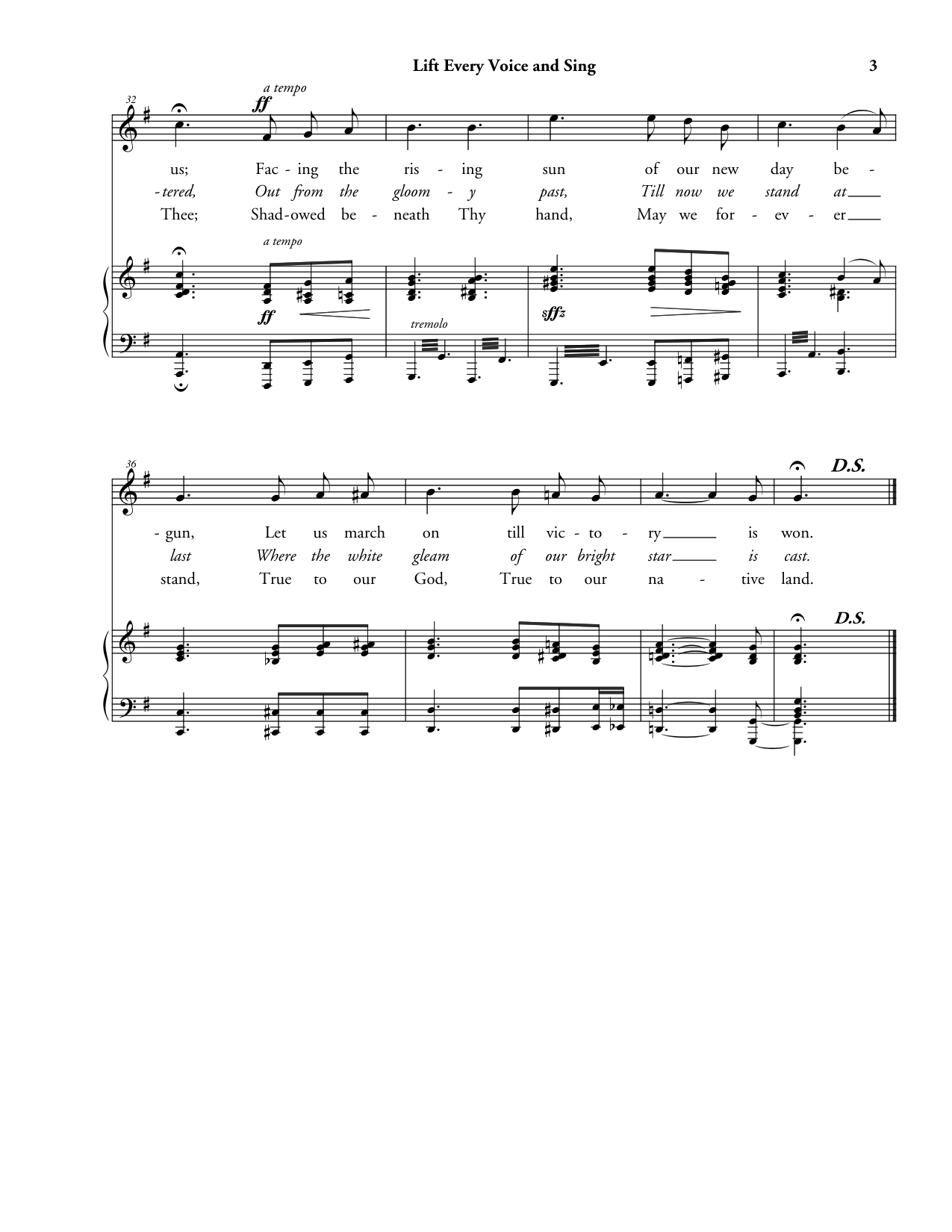
Page 1: Verse 1 Page 2: Chorus + Verse 2 Page 3: Verse 3 + End
All 3 pages stack — scroll down to flow through the song • tabs jump to a page • + / − or pinch to zoom • Ctrl+scroll to zoom • drag to pan • double-click to toggle zoom • fullscreen • use the SmartBoard pen to annotate

Phrase by Phrase – Today We Finish It

Frase por Frase – Hoy lo Terminamos
12:00

VERSE 1 (8 lines)

1. Lift ev’ry voice and sing,

2. Till earth and heaven ring,

3. Ring with the harmonies of liberty;

4. Let our rejoicing rise

5. High as the list’ning skies,

6. Let it resound loud as the rolling sea.

7. Sing a song full of the faith that the dark past has taught us,

8. Sing a song full of the hope that the present has brought us;

CHORUS (4 lines — this is what makes it complete)

1. Facing the rising sun of our new day begun,

2. Let us march on till victory is won.

(The chorus is the resolution. Verse 1 sets the question; the chorus answers it: "let us march on till victory is won.")

Teach order: phrases 1–2 echo → phrases 3–4 echo → phrases 5–6 echo → phrases 7–8 echo → chorus echo → full verse 1 + chorus together.

Three Rounds – A Cappella by Round 3

Tres Rondas – A Cappella en la Ronda 3

Round 1 – Soft (with track)

Track plays. Mr. Mbagwu plays piano. Sing softly to find the melody. Verse 1 + chorus.

Round 2 – Full (with piano)

Track off. Piano only. Full voice. Class carries the melody. Verse 1 + chorus.

Round 3 – A Cappella

No track. No piano. Just the room of voices — verse 1 + chorus. This is the goal.

Open on YouTube →
"Lift Every Voice and Sing" • James Weldon Johnson & J. Rosamond Johnson, 1900 • lyrics on screen • play UNDER Round 1 (soft) & Round 2 (full); MUTE for Round 3 (a cappella)
DOK 3 – ANALYZE

How did the room sound DIFFERENT in Round 3 (a cappella) than Round 1?

Why Group Singing?

¿Por Qué Canto Grupal?

Group singing is older than recorded history. Across cultures, communities sing together at births, deaths, work, war, worship, and protest. Breathing together, locking pitch together, waiting for the same downbeat – these synchronize human bodies.

El canto grupal es más antiguo que la historia escrita. Las comunidades cantan juntas en nacimientos, muertes, trabajo, guerra, culto y protesta. Respirar y afinar juntos sincroniza cuerpos humanos.
DOK 4 – ARGUE

Why has group singing been central to social movements – civil rights, churches, sports stadiums, protests? Use today's experience as evidence.

One Last Time, A Cappella

Una Última Vez, A Cappella

One last time through verse 1. A cappella. Stand if you choose. No critique. The room holds the song.

Una última vez por el verso 1. A cappella. Levántate si quieres. Sin crítica. La sala sostiene la canción.
DOK 4 – CREATE

Listen to the room around you. What did your voice add to the whole?

EXIT TICKET 5 Points • Classwork (40%) 03:00
Q1 – Vocal Technique (2 pts)

Name ONE vocal technique you used today (breath support, open vowels, or phrase shaping) and a moment in verse 1 where it helped.

Nombra UNA técnica vocal que usaste hoy y un momento del verso 1 donde te ayudó.

1 pt = Names a technique • 1 pt = Specific moment in verse 1

Q2 – Group Singing (3 pts)

Why has group singing been central to social movements – churches, civil rights, sports, protests? Use today's class experience as your evidence.

¿Por qué el canto grupal ha sido central en los movimientos sociales? Usa la experiencia de hoy como evidencia.

1 pt = Specific moment • 1 pt = Reasoned claim • 1 pt = Connection

📚 Submit on Google Classroom

Your Voice in the Room

Tu Voz en la Sala
In 1900, 500 schoolchildren sang this song for the first time. Today, you stood in that line. The voice you used today is the voice we needed today.
Take that with you. Singing is older than language. It is what people do when there is no other way to say what must be said.
"Sing to him a new song; play skillfully, and shout for joy."
– Psalm 33:3
← Wed Clave (P2)
navigate • F fullscreen • + zoom